Dive Into the Future

Why Liquid Cooling?


What is Liquid Cooling in Data Center ?
Liquid cooling system circulates liquid through a heat sink attached to the processor. Liquid cooling uses a coolant to transfer heat from your CPU, and sometimes the GPU as well as other components, to a radiator, where that coolant’s heat is dispersed by cooling fans before being circulated back to the CPU.
Liquid cooling systems, in particular, have become a sophisticated solution, available in both direct-to-chip version (cooling only specific components such as chipsets and GPUs) and immersion cooling (where all server components are submerged in a dielectric liquid).
Whilst liquid cooling systems offer enhanced thermal efficiency and reduced energy consumption, particularly in view of the increased computational demands and the use of more powerful microprocessors, they are not considered definitive solutions. It is estimated that approximately 10-20% of heat generated is still released into the air. Consequently, contemporary designs incorporate “hybrid” solutions that seamlessly integrate liquid and air-cooling systems.
How Liquid Cooling Works
Liquid cooling involves circulating a liquid through a loop that is connected to the components that need cooling. The liquid absorbs heat from the components and then flows to a heat exchanger, where the heat is transferred to the surrounding air or water. The cooled liquid then returns to the components, and the process starts over.

1. Direct-to-Chip (D2C) Cooling: ● Cold plates attach directly to processors, circulating coolant to remove heat efficiently. ● Ideal for high-density computing environments.
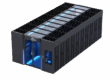
2. Immersion Cooling: ● Servers are fully submerged in a thermally conductive and electrically non-conductive liquid. ● Eliminates traditional fans and heat sinks, improving thermal management.
3. Rear Door Heat Exchangers (RDHx): ● Heat exchangers integrated into rear doors of server racks. ● Cools hot air before recirculation, enhancing efficiency.